Key findings
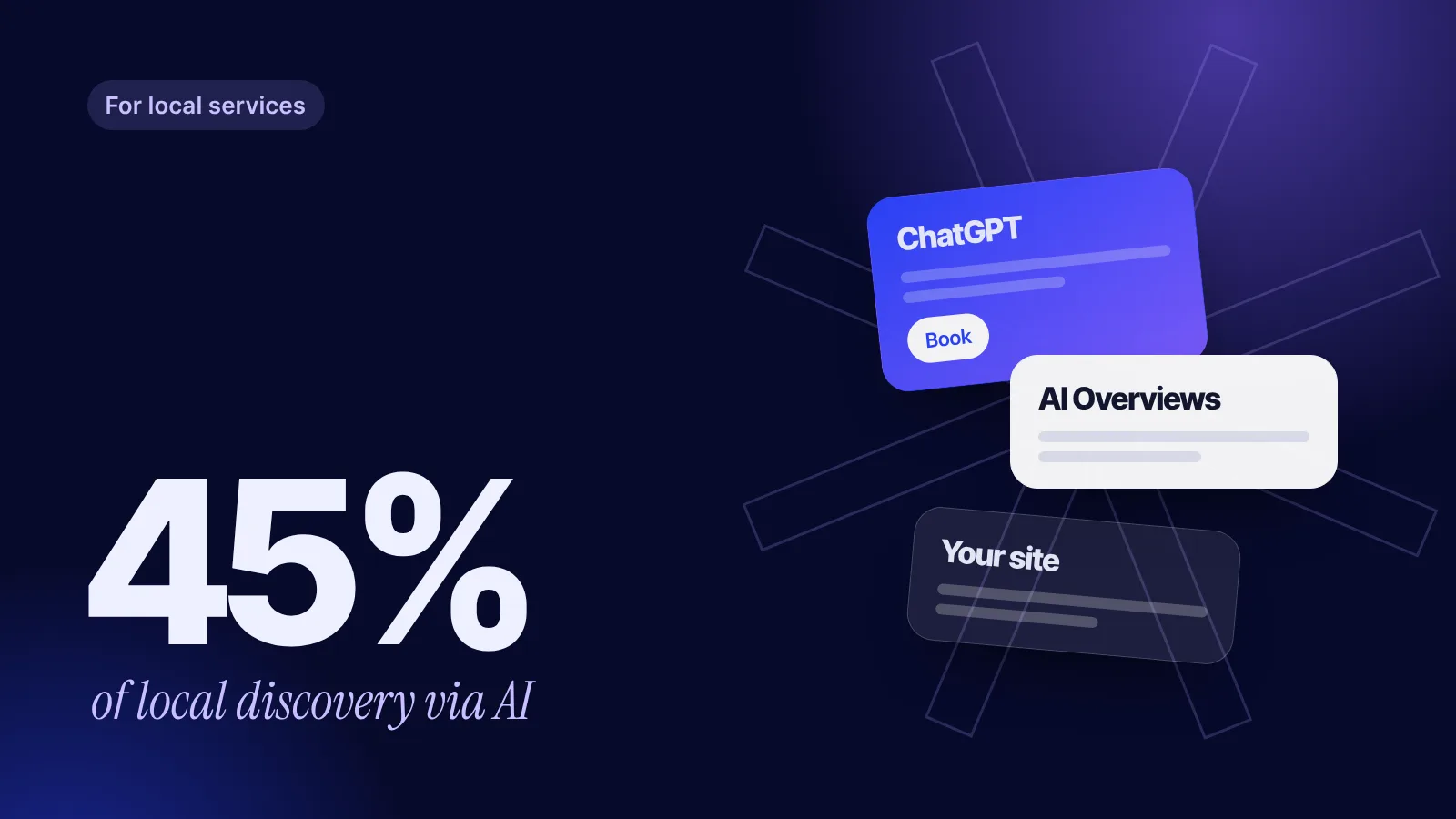
- AI tools now account for 45% of local business discovery in the US, up from 6% a year earlier (BrightLocal 2026 survey).
- Your own website is the most common source: 93% of unique domains AI cited were business sites (BrightLocal AI visibility study).
- Google Business Profile is the single biggest cited domain, at 28.63% of citations.
- People still check. Over 93% of AI users take at least one verification step, and 58% visit the business’s website (Yext).
- Google says there’s no special markup or “AI file” needed. The basics still win.
The shift, in numbers
A year ago, asking ChatGPT for “a good plumber nearby” was a novelty. In BrightLocal’s 2026 Local Consumer Review Survey of 1,002 US adults, ChatGPT and other generative AI tools accounted for 45% of local business discovery, up from 6% the year before. Google’s share fell from 83% to 71%. Yext’s own research puts it slightly differently but lands in the same place: 47% of US adults used AI to find a local business in the past month.
That doesn’t mean Google is gone. It means your customer now asks two or three places before they call you.
What AI assistants actually cite
BrightLocal ran 200,875 non-branded prompts across ChatGPT, Google AI Mode and AI Overviews for 1,342 business locations over 60 days, and analyzed 1.9 million citations. Three findings matter most for a small business:
In other words, the assistant reads your website and your Google profile more than anything else. If those two are thin, outdated or contradict each other, there’s little for it to work with.
Who gets picked
Being cited isn’t the same as being recommended. In the same study, Google Maps mentioned a tracked business in 66% of searches; the AI surfaces did so far less often (AI Overviews 38%, ChatGPT 33%, AI Mode 32%). Businesses with a fixed public address were mentioned more often than service-area businesses (33.6% vs 29.4%), and most picks (52.8–59.3%) were within 5 km of the searcher.
A separate index from the local marketing platform SOCi, reported in a vendor press release, found ChatGPT recommended just 1.2% of the 350,000+ locations it tracked. Treat the exact number with care, but the direction is clear: AI answers are short lists, and most businesses aren’t on them.
One more detail people miss: answers change. BrightLocal found only 20–33% overlap when the same search was repeated. Checking once and panicking (or celebrating) tells you little.
People still double-check, on your website
Yext’s 2026 research found that over 93% of AI users take at least one step to verify a recommendation. After getting one, 62% search on Google, 58% visit the business’s website and 52% click the cited sources. The top factors in what they do next are star rating (34%), word of mouth (30%) and how recent the reviews are (29%).
So the website still closes the deal. AI gets you on the shortlist; your site and reviews decide whether you get the call.
What you don’t need
An industry of “AEO” and “GEO” tricks has grown up around this. Google’s own guidance for its AI features, updated in July 2026, is refreshingly boring:
- There’s no special schema.org markup you need to add for AI features.
- Files like llms.txt are unnecessary for Google Search. They neither help nor hurt there.
- Don’t rewrite or “chunk” your content for AI. Write unique, useful pages for people.
- Do keep your Business Profile and (for stores) Merchant Center data complete.
Other assistants may use other signals, and structured data still helps with Google’s rich results. But the foundation is the same everywhere: clear pages, accurate business data and real reviews.
Action items
Tick them off as you go. Nothing here needs a developer to start.
- Fill in every field of your Google Business Profile: categories, services, hours, photos, and a description that matches your website.
- Give each service its own page with a plain answer to “what is it, who is it for, what does it cost, how do I book”.
- Make sure your name, address and phone match exactly across your site, Google, Yelp and Facebook.
- Ask happy customers for reviews every month. Recency matters as much as the total.
- Write an FAQ with the real questions people ask you on the phone.
- Once a month, ask ChatGPT and Google AI Mode the same three questions a customer would. Run each one three times and note who shows up.
- In Search Console, check the generative AI performance report to see how often you appear in Google’s AI features.
FAQ
Make your website and Google Business Profile complete, specific and consistent, and keep getting recent reviews. Those are the sources AI assistants cite most.
Google says llms.txt is unnecessary for Google Search. It does no harm, but it won’t replace clear pages and accurate business data.
Yes. Google still accounts for most local discovery, and people check AI recommendations on Google and on your website.
AI answers vary between runs. BrightLocal saw only 20–33% overlap on repeated searches, so track trends over several checks, not one answer.
Anastasia Dvorzhanska is the founder of Beginning, a women-founded design studio in Los Angeles. 12+ years designing websites, checkouts and brands for growing businesses. More articles
Sources (5)
- DesignRush News on BrightLocal’s 2026 Local Consumer Review Survey (Sep 2026)
- BrightLocal, Local AI Visibility Study (Sep 2026, updated Nov 2026)
- Yext, 7 data-backed facts on AI trust and consumer decision-making in 2026 (Apr 2026)
- Google Search Central, Optimizing your website for generative AI features on Google Search (updated Jul 2026)
- SOCi 2026 Local Visibility Index, as reported in a MapAtlas press release (Mar 2026)